
Meta Muse AI Agent: The New AI That Can Actually Do Things for You
Meta Muse AI Agent is here—and it could change the way we use AI forever.
For years, AI assistants have been remarkably good at answering questions, writing emails, creating images, summarizing documents, and generating ideas.
But there has always been one big limitation:
They usually tell you what to do instead of actually doing it.
Meta wants to change that.
On September 8, 2026, Meta launched Muse, a new personal AI agent designed to go beyond conversations and take action on a user’s behalf. Instead of simply responding to a prompt, Muse can create a plan, interact with connected services, and work toward completing a task.
And that makes Muse one of the most interesting AI launches of 2026.
What Is Meta Muse AI?
Meta Muse is a personal AI agent designed to understand your goals and help complete digital tasks.
Think of the difference this way:
Traditional AI:
“Here is how you can book a flight.”
AI Agent:
“I found the flight options, compared them, filled in the information, and I’m waiting for your approval before booking.”
That shift—from answering to acting—is what makes agentic AI so important.
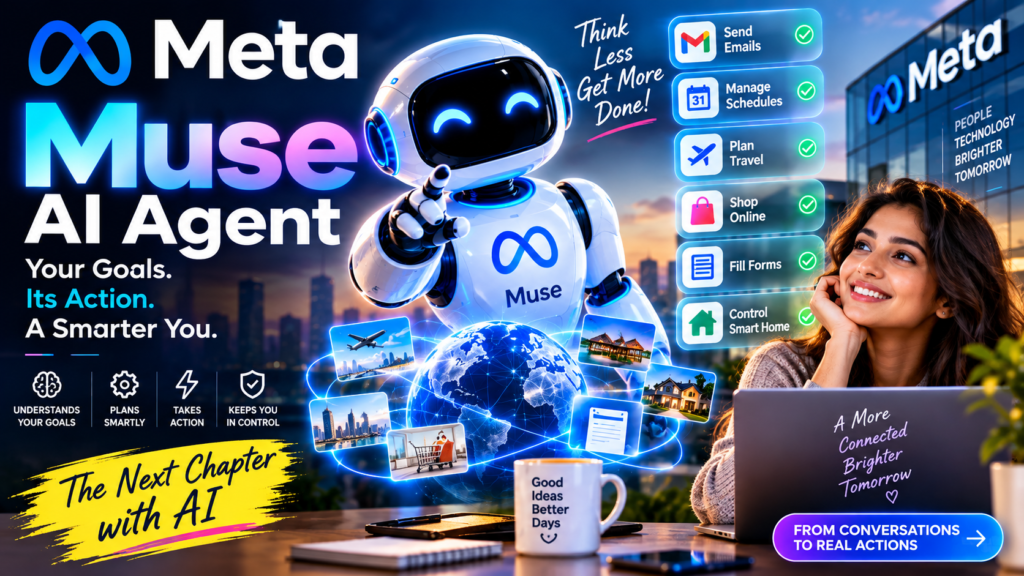
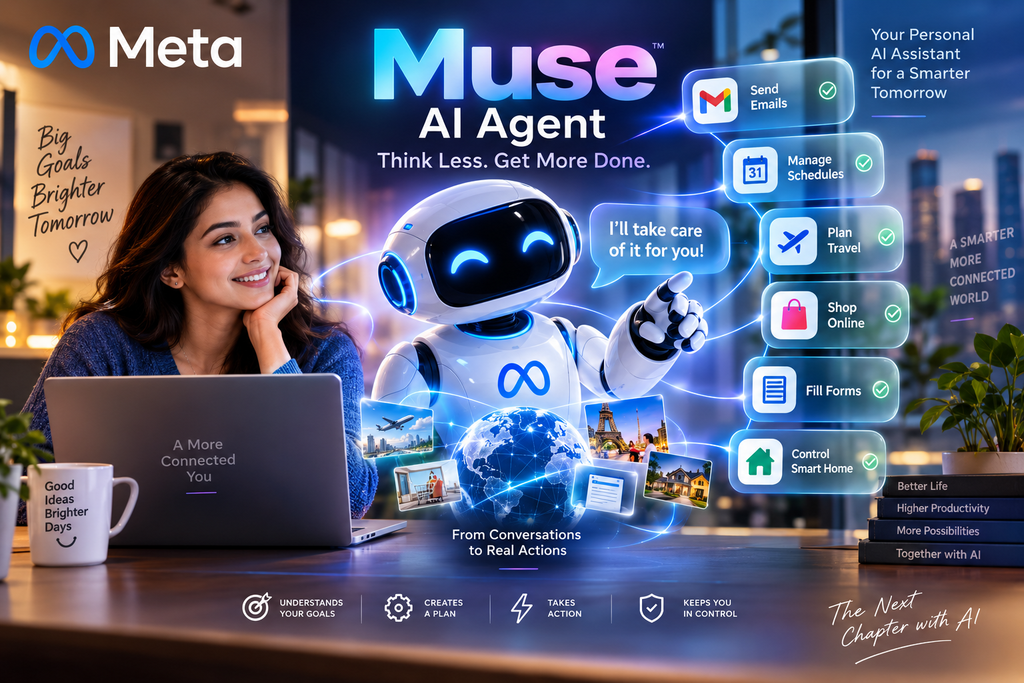
Meta says Muse can work with connected apps and services to handle tasks such as email, shopping, travel, scheduling, forms and other everyday activities.
What Can Meta Muse Do?
Muse is being positioned as an assistant that can take real work off your plate.
Some of the capabilities reported at launch include:
- 📧 Drafting and sending emails
- ✈️ Planning and booking travel
- 🛒 Shopping online
- 📅 Managing schedules
- 📝 Filling out online forms
- 🔎 Researching information
- 💳 Helping with purchases
- 🏠 Working with connected smart-home services
- 🎯 Working toward longer-term goals
- 🤝 Performing tasks across multiple connected services
Rather than requiring you to provide instructions for every individual step, Muse can develop an action plan and continue working toward the goal.
That is a major difference between a conventional chatbot and an AI agent.
Muse Is Designed to Keep Working
Perhaps the most exciting idea behind Muse is that it isn’t simply waiting for your next question.
You can give it a goal.
For example:
“Plan a three-day trip to New York under my budget.”
Instead of simply giving you a list of suggestions, an agent could potentially research flights and hotels, compare options, organize the itinerary and ask for approval when an important action needs your confirmation.
The concept is simple:
Tell AI what you want. Let AI figure out the steps.
Meta describes Muse as an agent that can understand goals, build an action plan, track progress and proactively take tasks off the user’s plate.
Meta Muse vs Traditional AI Chatbots
The biggest difference is agency.
| Feature | Traditional AI Chatbot | Meta Muse |
|---|---|---|
| Answers questions | ✅ | ✅ |
| Generates content | ✅ | ✅ |
| Creates plans | ✅ | ✅ |
| Uses connected services | Limited | ✅ |
| Performs digital tasks | Limited | ✅ |
| Works toward longer-term goals | Limited | ✅ |
| Can take actions for the user | Limited | ✅ |
| Requires approval for sensitive actions | Varies | Designed with controls |
The industry is increasingly moving from generative AI to agentic AI.
Generative AI creates.
Agentic AI creates + decides + acts.
And Muse is Meta’s biggest consumer-facing bet on that transition so far.
How Does Meta Muse Work?
Under the hood, Muse is powered by Meta’s agentic AI technology and operates inside a dedicated cloud environment.
One important part of Meta’s approach is its secure virtual machine, where the agent and user data are kept within a controlled environment. Meta has also described a security system called Sentinel, designed to govern what actions Muse can take online and when additional user approval is required.
This matters because giving an AI access to your email, calendar, shopping accounts or payment systems is very different from simply asking it a question.
The more an AI can do, the more important security becomes.
The Biggest Question: Can We Trust an AI Agent?
This may be the most important question surrounding Muse.
Imagine giving an AI access to:
- Your email
- Your calendar
- Shopping accounts
- Payment systems
- Travel information
- Personal conversations
- Other connected applications
The convenience could be enormous.
But the potential risks are enormous too.
Meta says users control which apps and services Muse can access, while its security architecture is designed to monitor and control potentially risky actions.
However, early reporting has also highlighted reliability and security concerns uncovered during testing. That means Muse’s success may depend not only on how intelligent it is—but on whether users are comfortable trusting it with real-world actions.
The future of AI agents may ultimately depend on trust more than intelligence.
Meta Muse and WhatsApp
Meta has another major advantage: its enormous ecosystem.
Muse is available through a dedicated experience and can also be accessed through WhatsApp in the initial U.S. rollout. Meta has also discussed expanding Muse toward its broader product ecosystem.
This could be strategically important.
Imagine saying in WhatsApp:
“Find me a good restaurant for Saturday.”
Or:
“Remind me to buy a gift next week.”
Or:
“Plan my weekend and tell me what I need to book.”
The interaction could eventually feel less like using software and more like messaging a personal digital assistant.
Meta Muse and the Future of Personal AI
Meta CEO Mark Zuckerberg has described the company’s broader AI ambition in terms of “personal superintelligence.”
Muse appears to be an important step toward that vision.
Instead of having separate apps for email, shopping, travel, calendars, research and productivity, users could increasingly have one AI layer connecting everything together.
That creates a fascinating possibility:
Your AI may become the interface to the internet.
Instead of:
Search → Website → Compare → Form → Payment → Confirmation
you might eventually say:
“Take care of this for me.”
The AI handles the workflow while you supervise the important decisions.
What Does Muse Mean for Businesses?
The impact may extend far beyond consumers.
AI agents could eventually transform:
- Customer service
- Online shopping
- Marketing
- Travel
- Personal finance
- Recruiting
- Sales
- Administration
- Research
- Small-business operations
For example, a small business owner could potentially tell an AI:
“Find five potential suppliers, compare their prices, draft emails to them and prepare a recommendation.”
Instead of generating a report about how to do it, an agent could increasingly perform the workflow itself.
That is why companies across the technology industry are racing toward agentic AI.
Meta’s Biggest Advantage
Meta has something many AI startups don’t have:
billions of users and a huge ecosystem of consumer products.
Facebook, Instagram, WhatsApp and Messenger already occupy a significant part of people’s digital lives.
If Meta can successfully place an intelligent agent on top of that ecosystem, Muse could become much more than another AI chatbot.
It could become a digital assistant embedded inside everyday communication.
That is potentially a much bigger opportunity.
But Muse Still Has Something to Prove
The launch is impressive—but the technology is still young.
AI agents face difficult problems:
Reliability: Will the AI complete tasks correctly?
Security: What happens if an agent makes a dangerous mistake?
Privacy: How much personal information should an AI be allowed to access?
Control: When should the AI act automatically and when should it ask permission?
Trust: Will people actually allow an AI to make purchases or send messages on their behalf?
These questions won’t be answered by benchmarks alone.
They will be answered by millions of real users.
Meta Muse vs ChatGPT, Gemini and Other AI Agents
Muse is entering an increasingly competitive AI-agent market.
OpenAI, Google, Anthropic and other companies are also moving toward AI systems capable of performing multi-step tasks.
The competition is no longer simply:
“Who has the smartest chatbot?”
It is becoming:
“Who can build the most useful, reliable and trusted digital agent?”
And that’s a much bigger battle.
Is Meta Muse the Future?
It may be too early to say.
But one thing is clear:
AI is moving from conversation to action.
The first generation of AI taught computers how to generate.
The next generation is teaching them how to act.
Muse represents Meta’s attempt to bring that idea to everyday consumers at massive scale.
If Meta can solve the difficult problems of security, reliability and trust, the impact could be enormous.
Imagine a future where you don’t need to learn dozens of apps.
You simply tell your AI what you want.
It understands the goal.
It creates the plan.
It does the work.
And it asks you when your approval matters.
That future is no longer science fiction.
Meta Muse is one of the clearest signs that it is beginning now.
Final Thought
The most important thing about Muse isn’t that it can send an email or book a trip.
It’s the philosophy behind it:
AI shouldn’t just answer your questions. It should help you accomplish your goals.
And if that vision succeeds, the next major evolution of the internet may not be another app.
It may be an AI agent that uses all your apps for you.
🔥 Meta Muse AI — Key Takeaways
What is it?
A personal AI agent from Meta designed to perform tasks rather than simply answer questions.
What can it do?
Email, travel planning, shopping, scheduling, web tasks, forms and other connected workflows.
Where is it available?
The initial launch is in the United States, including a dedicated app and WhatsApp access.
Why is it important?
Because it represents the shift from AI that responds → AI that acts.
The biggest challenge?
Trust, privacy, reliability and safe autonomous actions.
The bigger trend?
The rise of Agentic AI—AI systems that can plan and execute multi-step tasks on behalf of users.